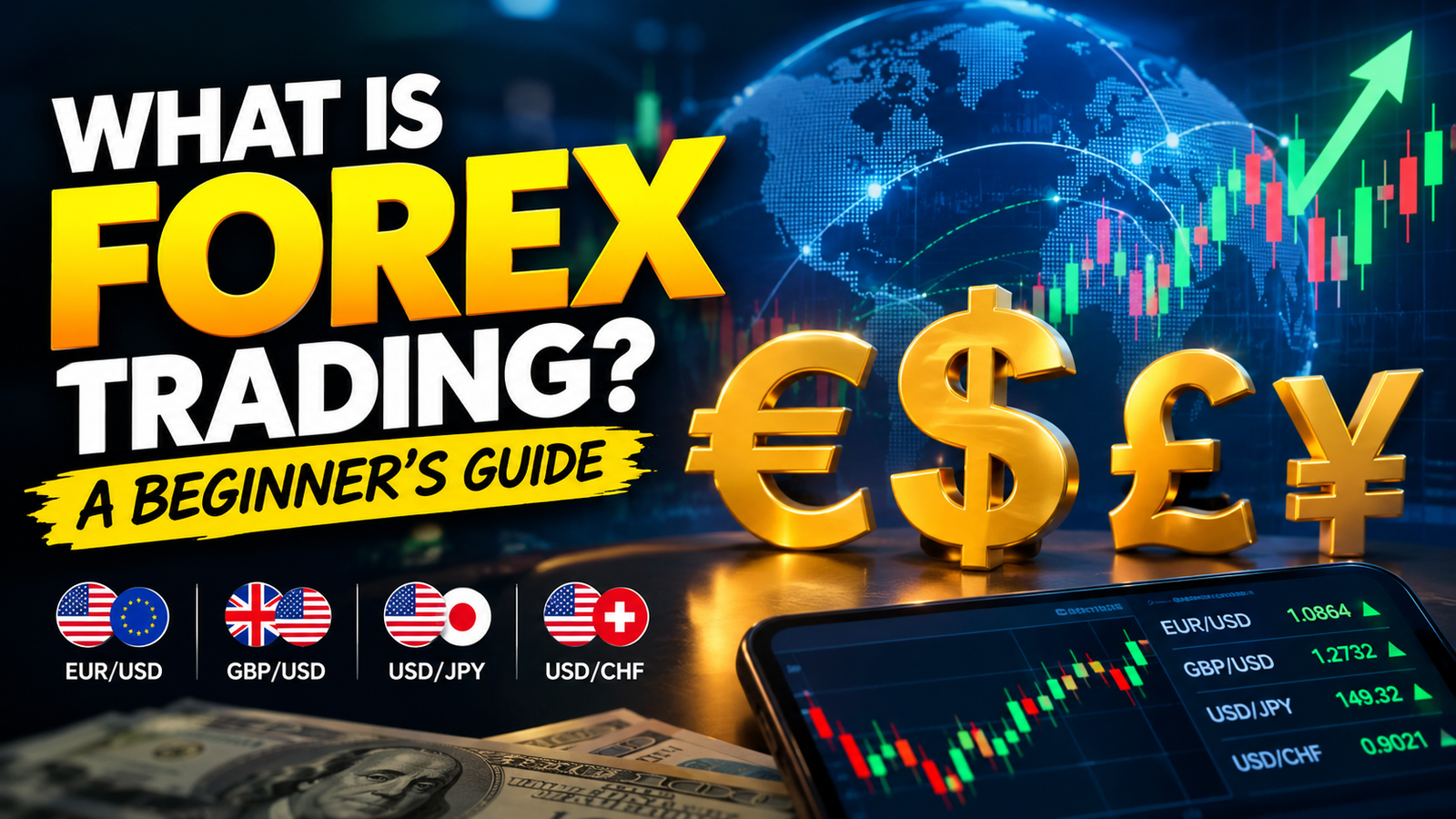
Forex trading, also known as foreign exchange trading, is the process of buying and selling currencies in the global financial market. The word “forex” comes from “foreign exchange.” In simple terms, forex trading involves exchanging one currency for another with the goal of potentially making a profit from changes in their prices.
For example, if a trader believes that the US dollar will become stronger compared with the euro, they may trade the EUR/USD currency pair. If the market moves in the direction the trader expected, they may make a profit. However, if the market moves against their prediction, they can lose money.
The forex market is one of the largest and most actively traded financial markets in the world. It includes major banks, financial institutions, governments, businesses, professional traders, and individual investors.
How Does Forex Trading Work?
Forex trading takes place through currency pairs. Some of the most commonly traded pairs include EUR/USD, GBP/USD, USD/JPY, and USD/CHF.
In a currency pair, the first currency is called the base currency, while the second is called the quote currency. For example, if EUR/USD is trading at 1.1000, it means that one euro is worth 1.10 US dollars.
A trader can potentially profit by predicting whether the value of one currency will rise or fall compared with another currency. If a trader expects the euro to strengthen against the US dollar, they might buy EUR/USD. If the euro strengthens as expected, the trader could potentially make a profit.
On the other hand, if a trader expects the euro to weaken against the dollar, they may sell the currency pair. If the market moves as expected, the trade could generate a profit.
Currency prices are influenced by many factors, including interest rates, inflation, employment data, economic growth, political events, central bank decisions, and global market conditions. This is why forex traders often follow economic news and market trends.
Benefits and Risks of Forex Trading
One of the main advantages of forex trading is its high liquidity. Because currencies are traded by participants around the world, the forex market has a very large trading volume.
Another feature is its accessibility. Individual traders can access the forex market through online brokers and trading platforms. Depending on the broker and account type, traders may be able to begin with relatively small amounts of capital.
However, forex trading also carries significant risks. Currency prices can change rapidly, sometimes because of unexpected economic or political news. A trade that appears promising can quickly move in the opposite direction.
Leverage is another important risk to understand. Leverage allows traders to control a larger position using a smaller amount of their own money. While this can increase potential profits, it can also magnify losses. A trader can potentially lose a significant portion of their account if leverage is used without proper risk management.
For this reason, forex trading should not be viewed as an easy way to make quick money. There is no strategy that can guarantee profits on every trade.
How Can Beginners Start Forex Trading?
Anyone interested in forex trading should first learn the basic concepts before risking real money. Important topics include currency pairs, pips, spreads, leverage, margin, market orders, technical analysis, fundamental analysis, and risk management.
A demo trading account can be a useful starting point for beginners. Demo accounts allow traders to practice using virtual money rather than real capital. This gives new traders an opportunity to become familiar with trading platforms and test strategies without immediately risking their savings.
Risk management should also be a major part of any trading plan. Traders should avoid putting all of their money into one trade and should carefully consider how much they are willing to lose. Tools such as stop-loss orders and appropriate position sizing can help manage potential losses.
Most importantly, beginners should approach forex trading as a skill that requires education, practice, patience, and discipline. Market conditions can change, and a strategy that works in one situation may not work in another.
Conclusion: Forex trading is the buying and selling of currencies with the aim of potentially benefiting from changes in exchange rates. While the market offers opportunities, it also involves substantial risk. Learning the fundamentals, practicing with a demo account, and developing strong risk-management habits can help beginners approach forex trading more responsibly.
I don’t even know how I ended up here, but I thought this post was great.
I don’t know who you are but certainly you’re going to a famous blogger if
you aren’t already 😉 Cheers!